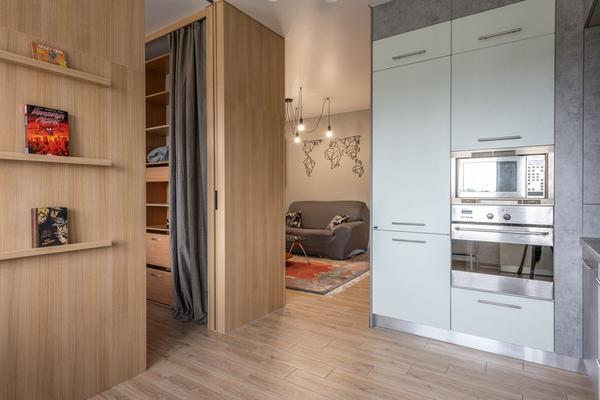
Small flats often have enough floor area for everyday life but not enough obvious places to put everything. The challenge is especially familiar in UK rentals, where fitted storage can be limited, rooms may have awkward alcoves, and tenants usually want solutions that do not leave holes or permanent alterations. The best approach is not to squeeze in more bulky furniture. It is to make better use of height, doors, gaps and furniture you already need.
Good small flat organisation starts by separating what must stay within easy reach from what can live higher up, under furniture or behind doors. Once that is clear, even a one-bedroom flat can feel calmer without sacrificing useful living space.
Use vertical space before buying more floor-standing storage
When floor space is tight, walls can do far more work. Freestanding ladder shelves, narrow bookcases and tension-fit shelving systems can add useful capacity without becoming permanent fixtures. Tall storage is particularly helpful because less-used items can sit above eye level while daily essentials remain easy to reach.
If your tenancy agreement allows wall fixings, shallow shelves can work above desks or low furniture, but check the wall type and landlord’s rules first. For renter-friendly storage, tall freestanding units can be more flexible than built-in cabinetry.
Turn doors into useful storage zones
Internal doors and cupboard doors are often overlooked. Over-door organisers can hold shoes, cleaning products, accessories or toiletries. In a small hallway, a slim hanging organiser on the inside of a cupboard door can keep gloves, umbrellas and reusable shopping bags from spreading across shelves and hooks.
Choose lightweight organisers and avoid overloading doors or hinges. Heavier objects are better stored lower down in a stable cabinet.
Make awkward alcoves earn their space
Many UK flats, especially conversions and older properties, have chimney-breast recesses, boxed-in pipes or narrow corners that standard furniture does not fit neatly. Measure these areas carefully and look for narrow shelving, stacking boxes or a slim console that uses the width without blocking movement.
A practical example is a 70 cm-wide alcove beside a chimney breast. A deep chest of drawers may project too far into the room, but a 25 to 30 cm-deep shelving unit can hold books, baskets and small electronics while keeping the walkway clear. This kind of compact home storage improves both capacity and circulation.
Use the space under beds and sofas properly
Under-bed storage is one of the most effective flat storage solutions because it uses space that otherwise collects dust. Low lidded boxes are ideal for spare bedding, off-season clothing and shoes. If your bed sits very low, only use risers designed for that frame and check that they remain stable.
For a sofa with clearance underneath, shallow containers can hold board games, cables or rarely used items. Transparent boxes make contents easy to identify, while labelled opaque boxes can look tidier.
Choose furniture that stores as well as it works
In a small flat, larger furniture should ideally solve more than one problem. An ottoman bed can replace several plastic boxes. A storage bench can provide seating and a home for shoes. A coffee table with drawers can hide chargers, remotes and paperwork. A dining bench with internal storage can work well where several chairs would take up more room.
Do not replace everything at once. Start with the item causing the biggest storage problem. If bedding is taking over a wardrobe, a bed with built-in storage may have more impact than adding another cabinet.
Create zones inside cupboards and wardrobes
Large cupboards can be inefficient when they have only one shelf and a deep empty cavity below it. Shelf risers, stackable baskets, drawer inserts and hanging organisers divide that volume into smaller usable zones. In wardrobes, slim hangers reduce wasted rail space, while fabric shelf units create sections for jumpers, bags and folded clothes.
Measure the internal width, depth and height before buying organisers. Small flat organisation works better when containers fit the cupboard rather than the other way around.
Use narrow gaps for slim storage
The gap beside a fridge, washing machine, wardrobe or bathroom cabinet may be narrow, but a slim rolling trolley can turn it into practical storage. These work well for tins, cleaning products, toiletries or laundry supplies.
Keep access and ventilation requirements in mind around appliances. Do not block vents, service access or heat-dissipation space specified by the manufacturer.
Keep visible storage calm
Open shelves can be useful, but too many small items on display can make a compact room feel busier. Group similar items in baskets or boxes and leave some visual breathing space. Display the things you enjoy seeing and contain the things that are purely functional.
Related internal topics that fit naturally here include small flat layout ideas, organising a small bedroom and storage ideas for compact kitchens.
Declutter before adding containers
Storage products cannot solve an excess of belongings. Before buying boxes, take one category at a time and remove duplicates, broken items and things you no longer use. This is especially useful in a rental because it reduces how much you need to move later.
Empty one drawer or shelf, decide what deserves to return, then choose storage only for the remaining items. That prevents buying organisers first and filling them with things you do not really need.
FAQ
What is the best storage idea for a very small flat?
Start with unused vertical and under-furniture space. Tall shelving, under-bed boxes and door organisers usually add capacity without taking much extra floor area.
How can renters add storage without drilling?
Freestanding shelves, over-door organisers, tension-fit systems, baskets and furniture with built-in storage are useful options. Follow product safety instructions and avoid attaching anything in a way that could damage surfaces.
How do I make a small flat look less cluttered?
Keep everyday items in defined zones, use closed containers for visually busy objects and avoid filling every open shelf. Repeating a small number of storage styles also helps rooms feel more coherent.
Should I buy storage furniture or storage boxes first?
Declutter and measure first, then identify the largest unresolved problem. If the issue is wasted space inside existing furniture, organisers may be enough; if you lack storage entirely, multifunctional furniture may be the better investment.
Make every storage choice earn its place
The most useful storage ideas for small flats are rarely the biggest. They are the ones that use space already present: the height of a wall, the back of a door, an awkward recess, the area below a bed or the unused volume inside a cupboard. By measuring carefully, keeping rental restrictions in mind and choosing non-bulky solutions, you can create a home that stores more without feeling more crowded.